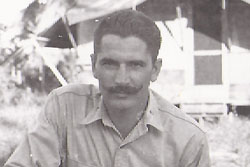
Interview with Major Joe Renner
Renner was a veteran of fighter operations on Guadalcanal, and his no-nonsense approach underlines the urgency of the situation halfway through the war. The tactics Renner prescribes for staying alive in an F4F while fighting Zeros are clear and compelling. His comments on the F4U Corsair and its reliability problems during early deployment are equally unvarnished. His discussion of morale issues, especially his remarks about pilots who find they can't face combat, provides a hard-core look at a seldom-discussed problem.
The excerpts below give a clear and forceful picture of the issues confronting fighter pilots - and their squadron commanders - at a point in the war when no one knew what the outcome would be.
U.S. CONFIDENTIAL BRITISH SECRET
NAVAER
Interview of
MAJOR J.N. RENNER, USMC
First Marine Aircraft Wing, Ass't Operations Officer
Commanding Officer VMO-251
Operations Officer MAG-11
in the Bureau of Aeronautics
17 July 1943
TRAINING
In training, I allowed one hour for solo, to get the pilots used to the airplane. The second hour they started flying section and division tactics. About the fourth hour they were in gunnery. We went through a very hurried syllabus, trying to cover everything we would need at Guadalcanal. One of the most important things is individual combat, the same thing we had practiced in peacetime, except that we took up two teams of four planes each, and got up there and mixed it up. There are going to be mid-air collisions in combat, and you may as well get used to looking out for seven other men in the sky besides yourself.
The most important rule I made was "stick together." The formation ultimately breaks up, but each wing man must stay with his section leader. What it amounts to is that several small columns revolve about each other. Whenever in training a pilot lost his section leader, I gave him hell.
TACTICS
Since there was time to practice only one pass, we emphasized the overhead pass in tactics against bombers. If a man can do the proper overhead pass, he can do an above-side from either side. A direct overhead pass gives the enemy less time to fire, and he can't bring his guns to bear.
We also stressed altitude work. We had pilots arrive at Guadalcanal who had never been above 15,000 feet; and out there on practically every hop we could expect to go up on oxygen. In the overhead pass that I speak of as being the primary pass against the enemy horizontal bomber, the training started in at 12,000 foot with a tow plane at 8,000 feet. We made one set of dummy runs and started firing on our second flight. The altitude was gradually increased, and firing stopped around 16,000 feet. We made runs on another fighter at 22,000 with the attacking planes at 26,000. A pilot who has made only low altitude passes around 10,000 to 15,000 feet misjudges his distance in rarified atmosphere and does not come in close enough to the target to get hits.
After all this training on how to attack enemy bombers, my squadron had a chance to attack twin-engine enemy bombers only once, and that time at an altitude of 500 feet! One of my boys said, "Gee, there they are! Let's get up above them and make that overhead pass." He started to climb; then realized that if he made the overhead pass it would be the end of him, not the enemy. In training, we had tried to cover each type of plane the enemy had, and the type of approach to be used against it. The twin-engine Mitsubishi had been used as a torpedo plane. The tactics against the torpedo plane was to make an above-rear pass or an above-side pass, pulling up above the target plane. So when this pilot saw the overhead pass wouldn't work, he immediately thought of making the above-rear pass. The squadron shot down five out of the six twin-engine bombers they encountered that day.
On the dive-bombers with the fixed landing gear, the theory was to get just low enough behind so that the rear gunner would have to shoot through his own horizontal stabilizer and elevator. We came directly in on practically a no-deflection shot from underneath to blast them.
Against the bi-plane float we cautioned pilots about maneuverability and the rear gunner, but explained that if you could get down below the stabilizer into the rear it was "duck soup."
Against the Zero, because of its maneuverability and climb, we used tactics developed by Foss, Bauer, and Smith. In order to knock Zeros down the Grummans stuck together, and each pilot paid less attention to the man on his tail than to the Zero on somebody else's tail. The Grumman fighters tried to stay in the same air, as we called it; once the dogfight started, we all revolved about in the same area. If a Zero dived out from the dogfight, our instructions were not to follow him but to swing back into the middle of the merry-go-round. In swinging back, you look for a Zero on some other Grumman's tail. This tactic worked out because a Zero can't take two seconds' fire from a Grumman and a Grumman can take sometimes as high as fifteen minutes' fire from a Zero. If you can summon up the courage in yourself to quit worrying about the guy peppering at you from behind end go after the Zero peppering your wing man from behind, gradually the Zeros all disappear from the fight; and only the Grummans are left. Now it's damn hard to instill in a pilot the idea that even though there is somebody on his tail he's got to work on the guy that's on another's tail. That's exactly what we did, however, and it worked out very successfully.
Naturally, the characteristics of the plane determine the tactics. The Zero could outmaneuver, outclimb, outspeed us. One Zero against one Grumman is not an even fight, but with mutual support two Grummans are worth between four and five Zeros, and so on up.
MORALE
After determining that a man wanted to be a fighter pilot, I asked him if he thought he was a "hot" pilot. One boy who was just coming in said, "No, sir." I said, "Then I don't want you." "Well," he said, "What do you mean? I've always been brought up with the idea that only senior pilots were hot pilots; that young pilots are supposed to keep their mouths shut and listen and learn how to fly." "Well," I said, "I want the hottest outfit that's ever been collected; and if you're not hot, there's no place here for you." He said, "Now that you bring it up, I'm the hottest boy that ever graduated from a naval training station." I said, "Okay." Well, it turned out he was pretty hot.
I tried to build up a winning spirit in the boys; tried to convince them that they were the very best; that there wasn't anybody who could beat them; that it was going to be fun to go out there and knock the [Japanese] down. It isn't always possible to convince them that it's going to be fun; but you can get them out there under one ruse or another; and if their first two or three combats are successful, and if their pals come back and say, "I knocked down two Zeros today," they soon get enthusiastic. If, however, the first flight goes out and gets its tails shot off, enthusiasm dies out in a great hurry. Our enthusiasm increased during the time we spent up there.
PILOT FATIGUE AND REPLACEMENT
We became greatly fatigued because of the hours we had to fly. In the Guadalcanal area, at least, pilots have been required to fly too many hours a day. For a period of six days, one group of fighter pilots were flying an average of six-and-a-half hours a day. The time we weren't flying, we were on scramble standby, which meant that we had to get up before daylight and either take off on a dawn patrol or assume a scramble standby. If we had to stand by, we were on that until noon; and then in the afternoon we flew a combat patrol over the area. Probably at 1645 we went out on a mission and came home after dark. It doesn't take long to burn the boys out at that clip.
The thing that bothers them more than anything else is this: they are sent into the combat area with a scuttlebutt rumor that they will come out in four weeks or five weeks, and [then]find themselves there indefinitely. Pretty soon they think, "Well, we're never coming out; they're just going to wait until we all get shot down and then they won't have to worry about pulling us out, and feeding in replacements all the time." If the going is tough, fighter squadrons should be relieved in three weeks' time. Otherwise they lose their desire to close with the enemy and their power to recuperate.
BUREAU COMMENT: Requests for replacement pilots have been filled to the extent permitted by the number available. Replacement squadrons and groups are formed as fast as pilots and planes are available. It is believed that an orderly rotation of duty in combat area can now be effected.
THE F4U
The boys flying the F4U are very enthusiastic about it. It's the first airplane I have flown that will do everything the manufacturer says it will do -- but it will only do it one day a week. The maintenance problem is terrific. Perhaps when our mechanics and our engineering crews are adapted to the plane and find out its idiosyncrasies, they will be able to straighten it out; and maybe we'll be able to get it to fly two days a week. The planes are very sturdy. A pilot from Fighting Squadron l24, who in one scrap with the [Japanese] shot down three Zeros, said the F4U would do everything the Zero would do except a tight flipper turn at low speeds. Whenever a Zero went into a tight flipper turn, he just poured on the coal and climbed back to altitude to make another pass.
EQUIPMENT
In the rear areas we had difficulty convincing pilots they should fly with their sleeves rolled down. Many of them pulled their shirts off after they left the ready room to get in the planes, and flew in their undershirts. They'd fly without goggles, and land with their hoods closed (takeoffs and landings should be with hood open; combat flying with hood closed) and do everything we told them not to do. But once on Guadalcanal, we never had to tell anybody to roll down his sleeves or wear his goggles on a flight. One or two of the boys came back with their faces filled with 20-mm shrapnel and pieces of broken plastic from the hood. The only parts of their faces not scarred up were the parts covered by goggles. They thought the goggles a pretty good thing.
One day on Guadalcanal when the field was wet and very muddy, the [Japanese] decided to make a big push and establish aerial supremacy over us. They came down about seven o'clock in the morning at 2,000 feet when all our fighters were on the ground. We were on the ground for a very good reason -- none of us could get in the air; we couldn't even taxi to the end of the strip to take off. (The tri-cycle landing gear and large tires of the P-38 and P-39 make them far superior to our planes when operating from a muddy field).
MORALE
Another thing that's affecting morale out there is the failure of some combat pilots after they arrive in the battle zone. A definite policy, I think, must be established. It's not so much what you do with the pilots who refuse to fight, or who find one excuse or other not to go out on a combat mission, as it is the effect the treatment given them has on the rest of the squadron. For a while the policy was to remove these people and send them back to the training bases to be instructors. Now there isn't a pilot out there who has been fighting the [Japanese] who doesn't want to come back to the U.S.A. It seems to them that the man who is a failure is the one who gets that reward. Although we're short of pilots and we're trying to turn out as many as possible, we'd do the combat operating outfit more good if we'd reach down and pull the wings off the chest of these boys. It wouldn't have to be done to many before they'd stop singing the song. And if a pilot says, "I haven't had enough training and I have to be trained a little more" -- under no circumstances send him back to the United States to get trained. Leave him down there; and when he's had sufficient training, send him back in. If he comes out with the same plea again, don't listen to him. Take his wings away; and if he's no good as a ground officer, take his uniform away. A letter went in from our Command suggesting wings be taken from these boys, and in some cases, uniforms too. They all began to flock around and say, "Well, if I'd known you were going to treat me like this I'd never have said a word. But old Joe Doe got to go home. He couldn't stand the gaff, and he's back instructing at Pensacola. I thought you'd do the same thing for me. I didn't have any idea you'd treat me as an outcast and take me off flight status, and just leave me sitting around here to do nothing, waiting for somebody to rule on what was going to happen to me." With a little strong arm, a little strict discipline, you'd find that type of person would practically disappear. They would turn in their wings of their own volition when they found themselves approaching the combat area.
Q. What percent of pilots do not wish to go into combat?
A. I'd say if you took a squadron of thirty pilots up there you could expect one to three of them to be "giggle girls," as we call them, or "rover boys." One of them will come up and admit that he's afraid to fly -- "Send me back, I've had enough." The other two will use different tactics. When the time comes to scramble, such a man will run out and jump in a plane, and it'll be dropping 300 r.p.m. on the left mag. He'll jump out and give it a down; the mech turns it up and it's dropping 25 on the right mag and 25 on the left mag. He'll run down the line and jump in another plane, anxious to get off with his outfit. He'll get his parachute on, his throat mike on, his gloves on, and be all ready to turn her up -- when he looks out and finds the left wing gone! The plane was one of the wrecks we had around the field to fool the [Japanese]. He runs to the next plane; and when he gets in, finds no engine in it. By that time it's too late to get off. And the same pilot that does it on Monday, does it on Tuesday. On Wednesday he's got a stomach ache, and he thinks he's getting malaria. By Monday of the next week he's ready to come back to duty; and he runs out; and, sure enough, his plane won't start (he's flooded it purposely). He gets in the next plane, and it's out of commission. He runs all around, and he can't find one that will go. That goes on day after day, until everybody gets to realize that he hasn't been up in the air. Finally you get one of these birdies in the air on a mission and look around and can't see him -- well, his prop went out, and he had to land again. It's impossible to get them into combat. Q. You suggested taking wings and uniform off them? Do you really recommend that we do that a few times?
A. Yes. The recommended plan was this. If a pilot entered a plea that he didn't think he had sufficient training, we would send him down to New Zealand or some place in the rear area, but still in the South Pacific, for further training. He would be placed on probation during that time. That training period would not exceed six months. The probation period would not count as part of his time in the South Pacific. Otherwise, you can see what would happen: some fellow with about six months to go would appear before the Board and get placed on probation, and at the end of the six months he'd come back to the States. He'd never have to go back in and fight, and he would have escaped all the way around. Well, if he's put on probation, the time not only would not count, but he could not be promoted. At the beginning of that six months' time he would be given his choice of what type plane he wanted to fly: fighters, or dive bombers, or torpedo planes. Sometimes they think they're in the wrong type. He'd get trained in the type he wanted to be in and come back. Then he'd be sent up with an organization to the front lines, and if he panned out, all would be forgiven. If he failed the second time, he would not rate a second period of probation. He would be through as an aviator. But it may be that he would be a good ground officer -- Engineering officer, an adjutant, or something like that, where he wouldn't have to fly. The Board could ask him if he wanted to try to be an aviation ground officer. If he said, "Yes," he could be given a trial. If he proved satisfactory, he could be carried on throughout the war as a ground officer. If he were a failure as a ground officer, he should be told, "You'd better get back and face your draft board, because you're not doing the job you took a pledge of allegiance and swore on oath to do, to defend the United States against all her enemies, as an officer. That plan, I think, would straighten that problem out in short order.
CASUALTY RATES
Q. Is the death rate among fighter pilots considered greater than in other types?
A. Definitely not. That's the reason I wanted to be a fighter! I think you've got a better chance of living. That's the feeling among the fighter pilots; I don't know how the rest of them feel. -- It goes deeper than that, though; I mean it is not just the fact that you think you have a better chance of living. It's that you close in and shoot down the enemy that interests most of the people. But I really feel a fighter pilot has a better chance of living. At least when you go, you know you're the one that didn't do it right!
COMPARISON OF AIRCRAFT
Q. What do Marines think of carrier-type aircraft?
A. I believe that all the active combat pilots in the Marine Corps agree with me on this: though at various times they have voiced loud criticisms of the Navy carrier plane and wished they had the Army P-38 or the Army P-51, they believe the Navy has scooped the Army on the F4U and the F6F. If Grumman or Vought were given the job of building a land-based fighter, they would be able to build a fighter superior to anything the Army now has and one which would be ideal for Marines or Navy squadrons based ashore. As the war in the South Pacific expands and there are more and more island bases to be held by the Marines and by the Navy, and ever-increasing number of squadrons, both Navy and Marines, will be land-based. I therefore see a need now for planning a land-based Navy fighter.